
Membrane vs Coating Waterproofing: Which Is Best for Malaysian Roofs?
Compare membrane and coating waterproofing methods. Learn which option suits your roof type, budget, and durability needs in Malaysia's tropical climate.
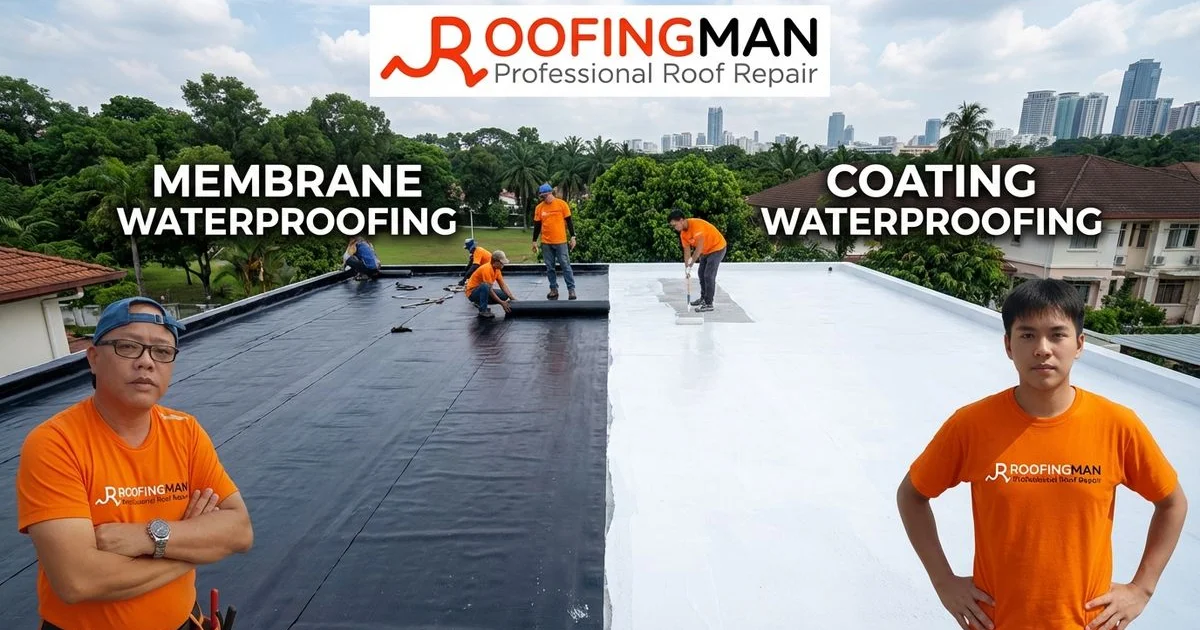
Choosing the Right Waterproofing for Your Roof
Waterproofing is one of the most important investments you can make for your Malaysian home. With annual rainfall averaging 2,500mm and some regions receiving over 3,000mm, your roof’s waterproofing layer is the primary barrier between monsoon rains and your living space.
The two most common waterproofing approaches used in Malaysia are membrane systems and coating systems. Each has distinct advantages and limitations, and the best choice depends on your roof type, budget, and long-term expectations. This guide provides a detailed comparison to help you make an informed decision.
Membrane Waterproofing
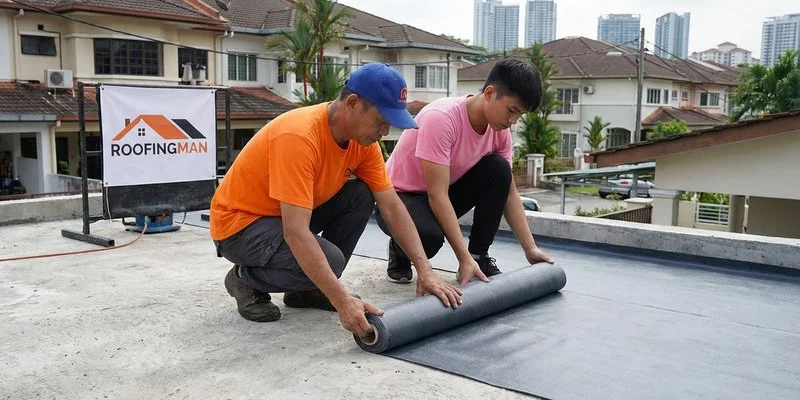
Membrane waterproofing involves applying a physical sheet or layer that creates a continuous barrier against water penetration. There are several types of membrane systems used in Malaysia.
Torch-Applied Bituminous Membrane
This is the most established method in Malaysia. Pre-manufactured rolls of modified bitumen are heated with a gas torch and bonded to the roof surface. The membrane is typically 3-4mm thick and provides a robust, durable barrier.
Advantages:
- Proven track record spanning decades in tropical climates
- Excellent puncture resistance
- Can bridge small cracks and structural movement
- Typical lifespan of 10-15 years with proper installation
Disadvantages:
- Requires skilled labour with torch equipment
- Fire risk during installation (open flame on the roof)
- Seams between membrane rolls are potential failure points
- Difficult to apply around complex shapes and penetrations
Self-Adhesive Membrane
A newer alternative that eliminates the need for torch application. These membranes have a peel-and-stick backing that adheres directly to a primed surface.
Advantages:
- No fire risk during installation
- Faster application than torch-applied systems
- Consistent bond quality (no skill-dependent torching)
Disadvantages:
- More expensive per square metre than torch-applied options
- Requires perfectly clean, smooth surfaces for proper adhesion
- Less forgiving of surface imperfections
Liquid-Applied Membrane
A hybrid category where a liquid compound is applied to the roof and cures to form a seamless membrane. Popular products in the Malaysian market include polyurethane-based and polyurea-based systems.
Advantages:
- Seamless application — no joints or overlaps
- Excellent for complex roof geometries and around penetrations
- Can be sprayed for fast coverage on large areas
- Typical lifespan of 8-12 years
Disadvantages:
- Requires precise mixing and application thickness
- Weather-sensitive during application (cannot apply in rain)
- Quality is highly dependent on applicator skill
Coating Waterproofing
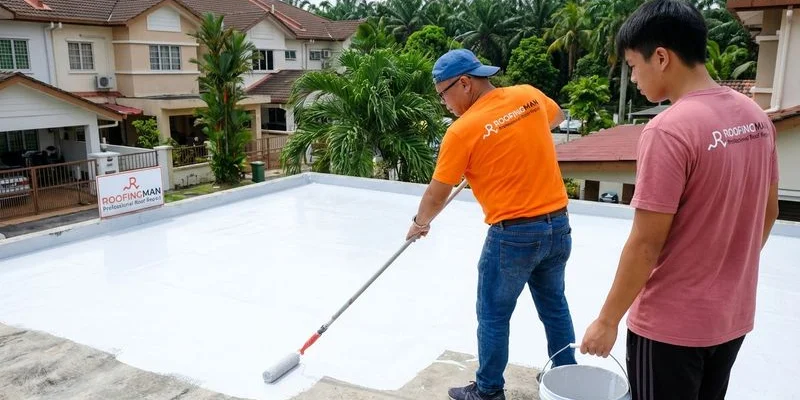
Coating systems are applied as liquid layers that cure to form a protective film on the roof surface. They are generally simpler to apply than membrane systems and are popular for maintenance and re-waterproofing projects.
Acrylic Waterproof Coating
Water-based acrylic coatings are the most accessible and affordable option. Available at most hardware stores in Malaysia, they can be applied with a roller or brush.
Advantages:
- Low cost (RM8 - RM15 per litre)
- Easy application — suitable for basic DIY
- Quick drying in Malaysia’s heat (2-4 hours between coats)
- UV resistant and available in various colours
- Reflective white coatings reduce roof heat absorption
Disadvantages:
- Thinner protection compared to membranes
- Requires re-application every 3-5 years
- Cannot bridge significant cracks (more than 1mm)
- Wears faster in areas with heavy foot traffic
Polyurethane Coating
A more durable coating option that provides better flexibility and water resistance than acrylic.
Advantages:
- Superior elasticity — can accommodate minor structural movement
- Better chemical resistance
- Longer lifespan than acrylic (5-8 years)
Disadvantages:
- Higher cost than acrylic (RM25 - RM45 per litre)
- Requires proper surface preparation
- Solvent-based options have strong fumes during application
- UV stability varies by product — some require a topcoat
Head-to-Head Comparison
| Factor | Membrane | Coating |
|---|---|---|
| Durability | 10-15 years | 3-8 years |
| Cost (material + labour) | RM15 - RM35 per sq ft | RM5 - RM15 per sq ft |
| Crack bridging | Excellent (up to 5mm) | Limited (up to 1mm) |
| Application complexity | Requires trained professionals | Can be DIY for simple roofs |
| Seamless coverage | Joints at overlaps (except liquid membrane) | Fully seamless |
| Re-application ease | Difficult — old membrane often needs removal | Simple — apply over existing coat |
| Heat reflection | Limited (dark surface) | Excellent with white/reflective coatings |
| Best for | New construction, major renovation | Maintenance, re-waterproofing |
Which Method Suits Your Malaysian Roof?
Choose Membrane If:
- You are building a new home or doing a major renovation
- Your flat roof is large (over 1,000 sq ft) and needs long-term protection
- The roof has structural movement or expansion joints
- You want a solution that lasts 10+ years with minimal maintenance
- Budget allows for higher upfront investment
Choose Coating If:
- You are maintaining an existing waterproofing system
- Your roof has complex shapes with many penetrations (pipes, vents, satellite mounts)
- You prefer a lower upfront cost and are comfortable re-applying every few years
- You want heat-reflective properties to reduce indoor temperatures
- The roof is in generally good condition with only minor deterioration
Consider a Combined Approach
Many Malaysian roofing professionals recommend a combined strategy: a membrane system as the primary waterproofing layer, topped with a reflective coating for UV protection and heat reduction. This combination extends the membrane’s lifespan while providing the thermal benefits of a reflective coating.
Malaysia-Specific Considerations
Tropical UV Exposure
Malaysia receives intense UV radiation year-round. This degrades waterproofing materials faster than in temperate climates. Choose products specifically rated for tropical or high-UV environments, and avoid generic products designed for cooler regions.
Monsoon Rain Intensity
Malaysian rainstorms can deliver 50-100mm of rainfall in a single hour. Your waterproofing system must handle not just the volume of water but the force of impact. Thicker, more robust systems perform better under these conditions.
Thermal Cycling
Roof surfaces in Malaysia can reach 70 degrees Celsius under direct sun and then cool rapidly during evening thunderstorms. This daily thermal cycling causes expansion and contraction that stresses waterproofing materials. Flexible systems — whether elastomeric coatings or modified bitumen membranes — handle this better than rigid alternatives.
Getting Professional Advice
Before choosing a waterproofing method, have a professional roofer inspect your current roof condition. The existing substrate, drainage patterns, and previous waterproofing layers all influence which method will perform best. A reputable contractor will recommend the approach that suits your specific situation rather than pushing whichever product they happen to stock.
Tags
Need Professional Help?
If you're dealing with this issue, our team can help. Get an honest quote today.