
The Complete Guide to Flat Roof Waterproofing in Malaysia
Flat roofs in Malaysia are prone to water pooling and leaks. This guide covers materials, methods, and costs for proper flat roof waterproofing.
Why Flat Roofs Need Special Attention in Malaysia
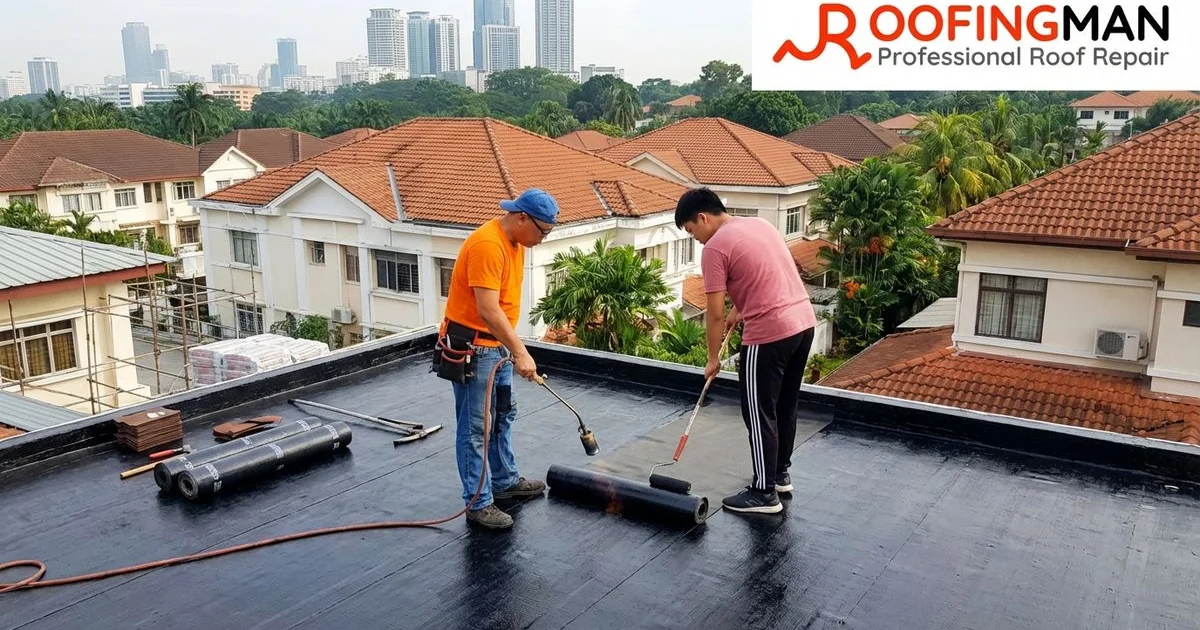
Flat roofs are a common feature in Malaysian architecture. From the concrete slab roofs of terrace houses to the expansive flat roofs of commercial shophouses, these structures serve practical purposes — they provide additional usable space, support water tanks, and house air conditioning units. However, flat roofs present a unique waterproofing challenge, especially in a country that receives some of the highest annual rainfall in Southeast Asia.
Unlike pitched roofs that shed water quickly through gravity, flat roofs rely entirely on their waterproofing layer and drainage system to prevent leaks. When this system fails, the consequences can be severe: persistent leaks, structural damage, mould growth, and expensive repairs.
This guide covers everything you need to know about keeping your flat roof watertight in Malaysia’s demanding tropical climate.
Understanding Water Ponding
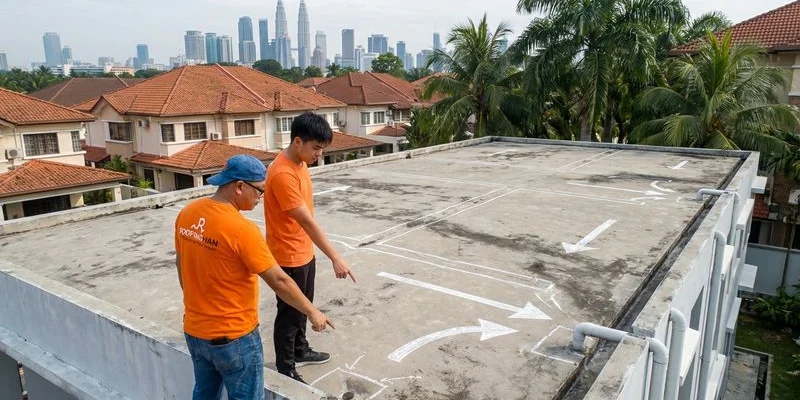
Water ponding — standing water that remains on a flat roof 48 hours or more after rain — is the primary enemy of flat roof waterproofing. Despite being called “flat,” these roofs should have a slight gradient (minimum 1:80 fall) directing water toward drainage outlets. Over time, structural settling, poor original construction, or debris accumulation can create low spots where water collects.
Why Ponding Is Dangerous
Standing water on your roof causes multiple problems:
- Accelerated waterproofing degradation — constant water contact breaks down even the best waterproofing materials faster than intermittent exposure
- Increased structural load — water weighs approximately 1 kg per litre. A 10-square-metre area with 50mm of standing water adds 500 kg of load to your roof structure
- Mosquito breeding — stagnant water on rooftops is a significant contributor to dengue mosquito breeding in Malaysia
- Algae and moss growth — biological growth can root into waterproofing layers and create penetration points
Identifying Ponding Areas
After rain stops, inspect your flat roof at intervals: immediately after rain, 24 hours later, and 48 hours later. Any area where water remains after 48 hours has a ponding problem. You can also look for telltale signs from below:
- Consistent leak spots that only appear during prolonged rain
- Circular or oval-shaped stains on the ceiling below the flat roof
- Green algae stains visible on the roof surface
Waterproofing Materials for Flat Roofs
Modified Bitumen Membrane (APP/SBS)
This is the most widely used flat roof waterproofing system in Malaysia. APP (Atactic Polypropylene) modified bitumen is preferred in tropical climates due to its superior heat resistance compared to SBS (Styrene-Butadiene-Styrene) varieties.
Application method: Torch-applied or self-adhesive Thickness: 3mm - 4mm (single layer) or 6mm - 8mm (double layer) Lifespan: 10 - 15 years Cost: RM12 - RM25 per square foot (installed)
For Malaysian flat roofs, a two-layer system is recommended — a base layer bonded to the concrete substrate and a cap sheet providing the finished waterproof surface. This redundancy means that even if the top layer is damaged, the base layer continues to protect.
Cementitious Waterproofing
A cement-based coating mixed with waterproofing additives, applied directly to the concrete surface. This method is popular for bathroom and balcony waterproofing but is also used on flat roofs.
Application method: Brush, roller, or trowel Thickness: 2mm - 3mm (multiple coats) Lifespan: 5 - 8 years Cost: RM6 - RM12 per square foot (installed)
Cementitious systems are rigid and do not accommodate structural movement well. They work best on smaller, well-supported flat roofs where minimal movement is expected.
Polyurethane Liquid Membrane
A liquid-applied system that cures to form a seamless, flexible waterproof layer. Increasingly popular in Malaysia for both new construction and re-waterproofing projects.
Application method: Spray, roller, or trowel Thickness: 1.5mm - 2mm Lifespan: 8 - 12 years Cost: RM10 - RM20 per square foot (installed)
The seamless nature of polyurethane makes it excellent for flat roofs with many penetrations — pipes, cable trays, and mounting brackets for satellite dishes and air conditioning units.
EPDM Rubber Membrane
A synthetic rubber sheet that is laid across the roof surface and adhered or mechanically fastened.
Application method: Full adhesion or mechanical fixing Thickness: 1.2mm - 1.5mm Lifespan: 15 - 25 years Cost: RM18 - RM35 per square foot (installed)
EPDM offers the longest lifespan but has a higher initial cost. It is more common in commercial and industrial applications in Malaysia but is gaining popularity for residential flat roofs.
The Correct Flat Roof Waterproofing Process
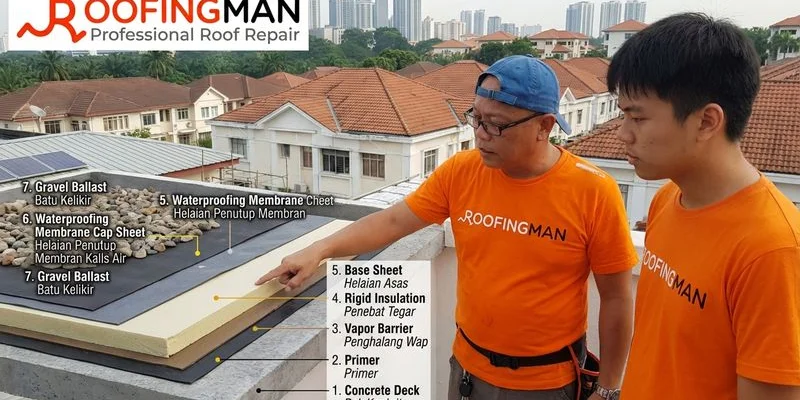
A professional waterproofing job follows a specific sequence. Skipping steps is the most common reason waterproofing systems fail prematurely.
Step 1: Surface Preparation
The concrete substrate must be clean, dry, and free of loose material. This involves:
- Power washing to remove dirt, algae, and old coating residue
- Repairing cracks wider than 0.5mm with epoxy or polyurethane sealant
- Filling low spots with screed or levelling compound to eliminate ponding areas
- Removing old waterproofing if it has debonded or is in poor condition
Surface preparation accounts for roughly 30% of a waterproofing project’s total time but determines 70% of the outcome. Cutting corners here leads to premature failure.
Step 2: Primer Application
A primer is applied to the clean, dry surface to enhance adhesion between the concrete and the waterproofing layer. The primer type must be compatible with the chosen waterproofing system — using mismatched products is a common mistake.
Allow the primer to cure fully before proceeding. In Malaysia’s heat, this typically takes 4-6 hours for most primers.
Step 3: Waterproofing Application
The chosen membrane or coating is applied according to manufacturer specifications. Critical details include:
- Minimum thickness — this is non-negotiable. Thin spots are future leak points
- Overlap widths for membrane systems — typically 100mm minimum at all joints
- Upstand height at walls and parapets — waterproofing must extend at least 150mm up any vertical surface
- Detail treatment around drains, pipes, and other penetrations — these are the most common failure points
Step 4: Protection Layer
On flat roofs that will experience foot traffic, a protection layer is applied over the waterproofing. This can be cement screed, protective tiles, or a specialised protection mat. Without protection, foot traffic from maintenance visits (servicing air conditioning units, cleaning water tanks) will damage the waterproofing over time.
Step 5: Drainage Verification
After the waterproofing is complete, verify that all drainage paths are clear and water flows correctly to the outlets. Pour water on the roof and watch its flow path. Any ponding areas must be addressed before the project is considered complete.
Common Mistakes to Avoid
Applying Waterproofing to Wet Surfaces
In Malaysia, afternoon thunderstorms can appear with little warning. If the contractor applies waterproofing to a damp surface, adhesion will be compromised. Professional contractors check moisture levels with a metre before application and schedule work for morning hours when rain is less likely.
Insufficient Upstand Height
The waterproofing layer must extend up walls, parapets, and any vertical surface by at least 150mm — ideally 200mm. Water can wick upward through concrete, and if the waterproofing stops at the floor-wall junction, leaks will occur at the base of parapets.
Neglecting Drainage Maintenance
Even the best waterproofing system will fail if drainage outlets are blocked. Leaves, debris, and sediment accumulate on flat roofs, especially near downpipe inlets. Schedule quarterly cleaning of all drainage points.
Ignoring Structural Cracks
Hairline cracks in concrete are normal and manageable. However, cracks wider than 2mm that grow over time indicate structural movement. Applying waterproofing over active structural cracks without addressing the underlying cause will result in the waterproofing splitting at those same locations.
Maintenance Schedule for Malaysian Flat Roofs
| Task | Frequency | Purpose |
|---|---|---|
| Visual inspection | Every 3 months | Check for cracks, blisters, or peeling |
| Drainage clearing | Every 3 months | Prevent ponding from blocked outlets |
| Professional inspection | Annually (before monsoon) | Detailed assessment and minor repairs |
| Re-coating (if coating system) | Every 3-5 years | Maintain waterproofing integrity |
| Full re-waterproofing | Every 10-15 years | Replace deteriorated waterproofing system |
Cost Planning
For a typical Malaysian terrace house with a flat roof area of 400-600 square feet, expect the following total costs for a professional waterproofing job:
- Budget option (cementitious coating): RM2,400 - RM7,200
- Mid-range option (modified bitumen membrane): RM4,800 - RM15,000
- Premium option (polyurethane liquid membrane): RM4,000 - RM12,000
- High-end option (EPDM rubber): RM7,200 - RM21,000
These prices include surface preparation, primer, waterproofing material, labour, and basic protection. Additional costs may apply for extensive crack repair, screed levelling, or difficult access requiring scaffolding.
Investing in quality waterproofing now prevents the far greater expense of water damage repairs later. A well-executed waterproofing system pays for itself many times over during its service life.
Tags
Need Professional Help?
If you're dealing with this issue, our team can help. Get an honest quote today.